
The 21st Law Commission said the special status given to the entity of HUF was a 'so-called gift by the British', who could not comprehend the complex socioeconomic structure of Indian families. 'Now, this status is being used for the evasion of tax only,' it said.
In UP and Bengal, it is willing to sacrifice its interests to stop the BJP and would work towards ensuring the BJP did not win incremental seats in Odisha and Telangana.

It should announce its candidates 45 days before the elections; trust rooted leaders; start its campaign focused on five guarantees six months before elections.
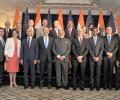
Prime Minister Narendra D Modi's itinerary for his June 21-24 US visit could include an address to a fledgling business advocacy group, the US-India Strategic Partnership Forum.
'Karnataka's finances are much healthier than the Union government's, which is indebted to nearly twice the extent of the state.'

Both the BJP and Congress understand that coalitions and alliances are not just about numbers, but have symbolic value.

The BJP's challenge is whether it can again deflate a Congress, which now looks reinvigorated and has adopted sharper messaging around its 'guarantees', and several regional parties, especially in Bihar, Maharashtra and West Bengal.

With Lok Sabha elections months away, the visits are vital politically as these would showcase Modi's standing as a world leader to the home electorate.
'It is not just about numbers. Sometimes coalitions and alliances have symbolic value.'

'I am seven months into the job, but it feels like seven years.'

In an unprecedented action, Indian aviation regulator DGCA has directed low-cost airline Spicejet to operate only 50 per cent of its flights for eight weeks. This follows an unusually high number of incidents involving the airline, raising safety concerns. The curtailment of capacity is unlikely to have any commercial impact on the airline owned by entrepreneur Ajay Singh. SpiceJet already operates less than 50 per cent of the flights it had filed for the summer schedule.

Tata group-owned AirAsia India's inability to get approval for international flights is hurting UDAN, the Indian government's regional air connectivity project that also aims to link cities in Northeast India and Odisha to places abroad. Sources said the civil aviation ministry is waiting for the low-cost airline to come under the full ownership of Tata Sons and become part of Air India, the former state-owned carrier now owned by the private conglomerate, before allowing it to operate international flights. Tata owns 84 per cent stake in AirAsia India and it is understood that the group will complete the process of buying rest of the stake by July's end.

Failure to reinstate salary even two years after the drastic cuts has landed the airline industry in a massive industrial relation crisis. While employees of Air India had organised a strike back in 2011, it is for the first time that private airlines are facing serious stress related to workers. IndiGo witnessed two of them, back to back. In the first instance, around 50 per cent of the IndiGo flights were delayed as a large number of crew members went on mass sick leave, apparently to participate in a rival airline's walk-in job interview.

Jet Airways is looking to lease around 20 Airbus A320 aircraft from lessors by 2024 as it aims to restart operations and fly international routes in the next one-and-a-half years. Jet's A320 aircraft fleet, according to sources, will be a mix of the Ceo and the more fuel-efficient Neo variants. These planes were originally intended for Russian airlines but could not be delivered following western sanctions on Russia over its Ukraine invasion.

More than 1,600 employees of Air India, the former state-run carrier now owned by the Tata group, have opted for voluntary retirement under a scheme announced on June 1. These employees comprise 22 per cent of permanent staff (around 7,000). The airline has a total employee strength of around 10,800, including those on contract.

Even as Union ministers allay misgivings over Agnipath, figures show a meagre 2.4 per cent of the ex-servicemen who applied for a government job could get one as the Centre and the states have been unable to recruit against the reserved quotas. Public sector undertakings (PSUs), ministries, and officials of Sainik Boards have blamed it on the lack of skill among ex-servicemen. They say veterans' inability to qualify in selection exams is one of reasons for this. Also, non-recognition of qualifications obtained from the military are reasons why their recruitment has remained significantly low, pushing them towards low-skill jobs.

'We should have calmed down the child. We will do an internal analysis on that.'

An opportunity to enter a burgeoning sector at a low valuation and favourable policies are propelling some of India's largest corporate groups to scoop up drone start-ups. "Indian corporations lost the race in aerospace and space tech. "No one wants to miss the bus this time. "These are seasoned businessmen and they realise that the market cap of tech companies with problem-solving capabilities will exponentially rise in future," says Vipul Singh, CEO of Aarav Unmanned Systems (AUS).
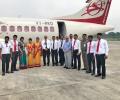
Tata-owned Air India has launched a Voluntary Retirement Scheme (VRS) for its employees- in the airline's first drive to reduce headcount. The salt-to-steel conglomerate acquired the carrier last year. As of November 2019, the airline had 9,426 permanent employees.

Hundreds of pilots are staring at a long wait to get the job of their dreams after completing the course, the cost of which runs to Rs 1 crore.
 © 2026 Rediff.com - Advertise with us - Disclaimer - Privacy Policy - Sitemap - Feedback - About us - Terms of use - Grievances